
VIP member
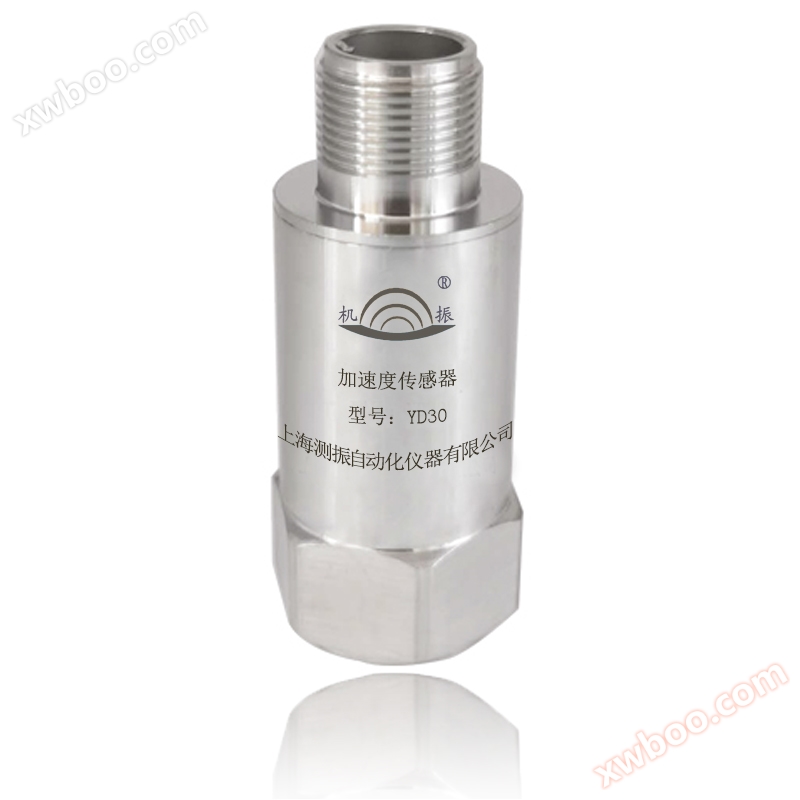
YD30 accelerometer sensor
The YD30 series integrated acceleration sensor is widely used for monitoring the operating status of equipment in various industries. The vibration le
Product details
YD30An acceleration sensor is an integrated sensor that is made up of conversion, measurement, and amplification circuits by micro machining an acceleration sensitive component on a piece of polycrystalline silicon.YD30There are three main purposes: state monitoring, impact measurement, and tilt angle measurement. The vibration output signal is filtered and detected to provide accurate and intuitive indications of the equipment's vibration magnitude, and to monitor whether the equipment is operating normally. Impact measurement is widely used in car airbags and seat belt systems to protect the lives of passengers. Tilt angle measurement is a function of the arcchord relationship between the output and tilt angle when the sensor is tilted. When the tilt angle is small, it approximates a linear relationship.
YD30Has excellent stability, reliability, and dry resistance. Ordinary acceleration sensors usually need to be calibrated on a standard vibration table, which brings inconvenience to use.YD30By adopting advanced microelectronic processing technology and capacitive measurement principle, excellent low-frequency response can be obtained through gravity accelerationgThe sensor can be standardized and equipped with a built-in self-test system.
1、 Basic parameters
●Sensitivity: 20mV/g~3V/g optional
Nonlinear: 0.2% FS
Frequency response: 0-20kHz (-3dB)
● Temperature drift: ≤ 0.01%/℃ (-20~+125 ℃)
Resolution: 0.05%
Power supply voltage:+24V (2-10mA constant current)
● Measurement range:
± 80 g (UB= 24 V...30 V)
± 40 g (UB= 20 V)
± 20 g (UB= 18 V)
● Maximum impact capacity: 10000g
Lateral sensitivity: ≤ 7%
Magnetic field sensitivity:<0003 g/mT
Strain sensitivity:<00003 g/(µ m/m)
Frequency range: 3 Hz... 10 kHz (± 0.5 dB)
1 Hz ... 15 kHz (± 3 dB)
● Resonance frequency: 20kHz
Noise: 0.1 Hz-100 kHz ≤ 0.6 mVSS
0,1 Hz- 1 kHz ≤ 0,2 mVss
Output impedance: ≤ 5 Ω
● Open circuit: -12 V ± 2 V
Output signal: AC: 0-5V
Working temperature: -20 to+80 ℃
● Protection level: IP64
Shell material: stainless steel (other materials can be used according to user requirements)
2、 Appearance size


1、 Installation method
Tighten the device under test with bolts.

picture1 installation diagram
2、 Calibration method
YD30Series integrated acceleration sensors generally do not require secondary calibration. If necessary, gravity acceleration can be usedgMeasure the actual sensitivity and correct it with a secondary instrument. For example, a certain integrated accelerometer has a range of ±2gThe standard sensitivity is 1V/gOutput it when it stands upright perpendicular to the horizontal plane2.5VDC voltage, when placed horizontally, outputs as1.55VThe actual sensitivity of the integrated accelerometer with DC voltage is(2.5-1.55)V/g.

picture2 Calibration diagram

Online inquiry
-
Contacts
-
Company
-
Telephone
-
Email
-
WeChat
-
Verification Code
-
Message Content
-