
VIP member
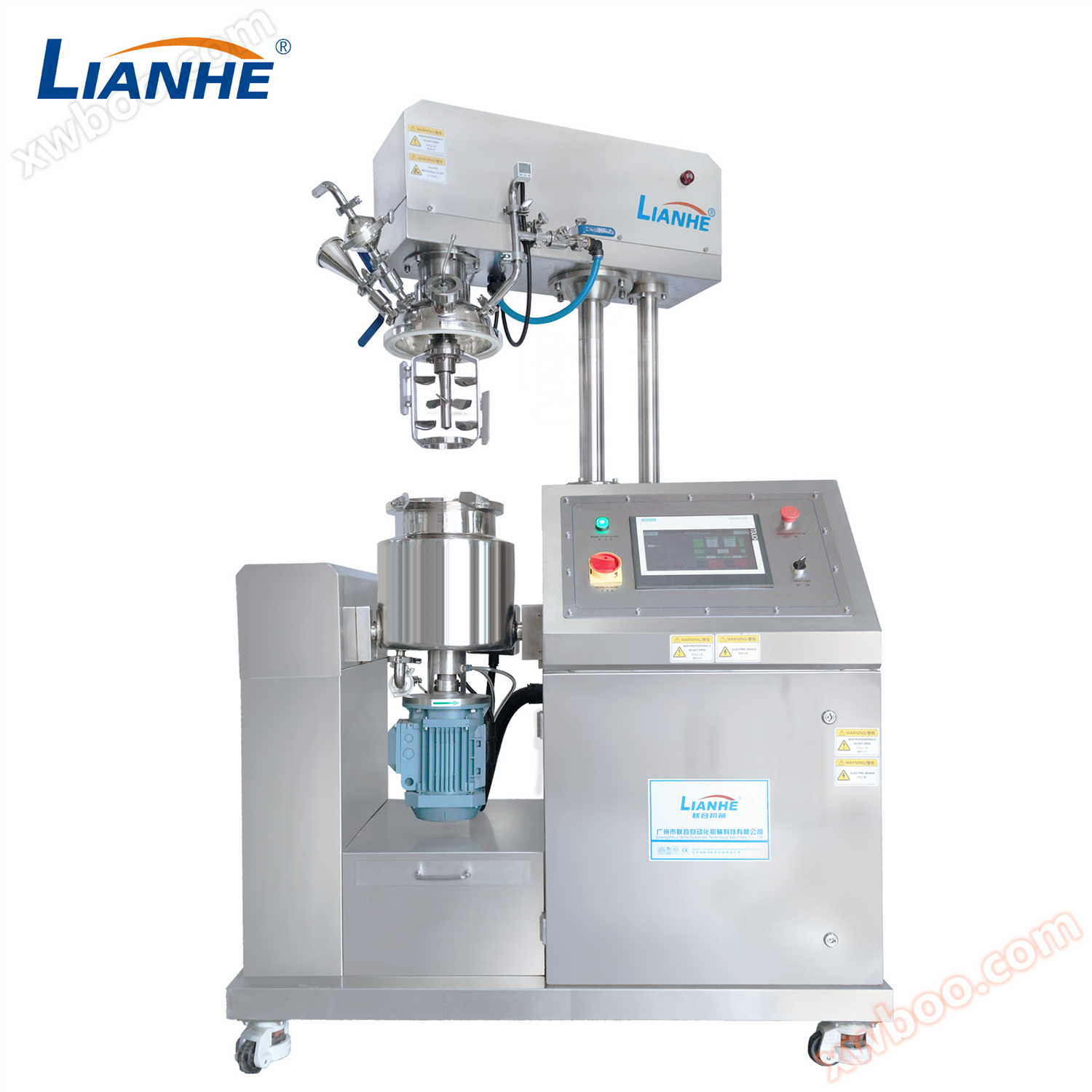
VME-5L vacuum emulsifier
Model: VME series Brand: LIANHE Purpose: various creams, lotion, high viscosity materials Laboratory proofing or pilot test Features: frame type wall
Product details
Product Introduction
Product Introduction:
The vacuum emulsifier is mainly composed of a pretreatment pot, a main pot, a vacuum pump, hydraulic and electrical control systems, etc. Vacuum emulsifier refers to the use of a high shear emulsifier to quickly and uniformly distribute one or more phases into another continuous phase in a vacuum state. With the strong kinetic energy brought by machinery, the material can withstand hundreds of thousands of hydraulic shear cycles per minute in the narrow gap between the stator and rotor. Through the combined effects of centrifugal extrusion, impact, tearing, and other processes, the emulsion is instantly and uniformly dispersed. After high-frequency cycles, high-quality products with no bubbles, delicate texture, and stability are finally obtained.
Product application:
Vacuum emulsifier is commonly used in biomedicine; Food industry; Daily care products; Paint and ink; nanometer material; Petrochemical industry; Printing and dyeing auxiliaries; Paper industry; Pesticides and fertilizers; Plastic rubber; Power electronics; Other fields such as fine chemicals.

Characteristic description:
1. Bidirectional frame scraping and mixing, seamless welding of blade blades, fully polished, no dead corners, no residue;
2. Bottom homogenization, German technology high shear tooth shaped homogenizer head, capable of producing high-end emulsion products;
3. Vacuum extraction and defoaming, equipped with a high-power oil ring vacuum pump. During the feeding process, the pot is evacuated to a negative pressure state to minimize bubbles in high viscosity materials;
4. The lid of the pot can be raised and lowered, and the main pot can be emptied and discharged;
5. Electric heating, circulating water cooling.
6. Compared to simple laboratory homogenizers, laboratory vacuum emulsifiers are directly connected to production type vacuum emulsifiers to conduct preliminary sampling and pilot testing of products, in order to obtain accurate production processes, technical parameters, and provide solid technical support for mass production.
7. Double end mechanical seal, with two end seals. If the first seal fails, the second seal can still seal to prevent leakage.
working principle:
After the materials are mixed and reacted in the water and oil pots through heating and stirring, they are sucked into the emulsification pot by a vacuum pump. The center stirring and polytetrafluoroethylene scraper in the upper part of the emulsification pot always conform to the shape of the stirring and blocking pot, sweeping away the wall sticking materials, so that the collected materials continuously produce a new surface. Then, through the cutting, compression, and folding of the blades and rotating blades, they are stirred and mixed, and flow downwards to the homogenizer below the pot. The materials are then cut in the shear joint by the strong cutting, impact, turbulence and other processes generated between the high-speed rotating cutting wheel and the fixed cutting sleeve. The materials are quickly crushed into particles of 200nm-2um. Due to the vacuum state inside the emulsification pot, the materials are stirred and mixed, and flow downwards to the homogenizer below the pot. The bubbles generated in the process are promptly removed.
Product Details

Online inquiry
-
Contacts
-
Company
-
Telephone
-
Email
-
WeChat
-
Verification Code
-
Message Content
-