VIP member
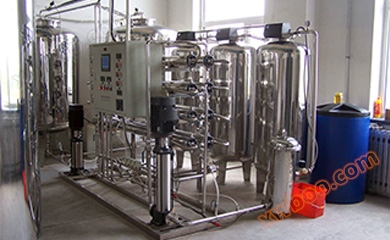
Three Continents Reverse Osmosis Pure Water Equipment
Introduction to Three Continents Reverse Osmosis Pure Water Equipment Reverse Osmosis Pure Water Equipment: 1. The reverse osmosis pure water equipmen
Product details
Three Continents Reverse Osmosis Pure Water Equipment
Introduction to Reverse Osmosis Pure Water Equipment:
1. The reverse osmosis pure water equipment adopts a fully automatic control mode to achieve fully automatic operation and reduce the impact of human error on the equipment belt
2. Adopting a reduction system design in the pretreatment system to solve the irreparable impact of excessive residual chlorine on the reverse osmosis membrane
3. In the selection of reverse osmosis membranes, Dow reverse osmosis membranes imported from the United States are selected, with a service life of up to 3 years and a effluent conductivity of less than 5us.
4. Choose Southern special SUS304 stainless steel water pump for the pump series, which has low operating noise
5. By using professional design software, the recycling rate can reach over 65%.
The high degree of automation, simple operation, stable water quality, and low operating costs have been highly praised by customers. And widely used for production water in various industries.
7. Adopt process management and continuous improvement concepts in the management mode, comply with ISO9001 requirements, continuously meet customer needs, and achieve customer satisfaction.
8. In terms of sales methods, direct sales from manufacturers without intermediate links can greatly save you costs.
Functional description of each component and accessory of the equipment:
1. Self supplied water tank: mainly solves the problem of unstable tap water pressure and reduces mechanical failures caused by frequent start-up or unstable tap water pressure of the lifting pump during operation.
2. Quartz sand filter: Tap water enters from the upper end of the tank and flows evenly from the upper end of the filter layer to the lower end through the upper water distributor. After passing through the filter layer, tap water is separated from the filter layer by the lower water distributor, forming filtered water.
3. Activated carbon filter: The internal structure of the activated carbon filter is identical to that of a quartz sand filter. After adsorption by activated carbon, the residual chlorine in tap water can generally be reduced to below 0.1mg/l.
4. Precision filter: mainly uses a 5us melt blown filter element, which can remove small particles and further create conditions for reverse osmosis inlet water.
5. High pressure pump: provides the necessary power for reverse osmosis operation.
6. Reverse osmosis system: The reverse osmosis system is the core component of reverse osmosis pure water equipment. In the design of reverse osmosis, the number, brand, and arrangement of filter membrane elements are mainly considered.
7. Pure water tank: used for storing pure water.

R.O Pure Water Treatment MachineSystem control and advantages:
R.O Pure Water Treatment MachineThe system has two control modes: manual and automatic, which can meet the following requirements:
1. Automatic water replenishment from the incoming water tank: When the liquid level in the incoming water tank reaches a low level, automatic water replenishment is performed. Stop replenishing water when it reaches a high level
When the water level in the incoming water tank reaches a certain level, the system starts working, and stops when the pure water tank is full.
When the incoming water tank is at a low water level, the water shortage protection is activated, and the system completely stops. Both manual and automatic operations cannot be performed.
4. The reverse osmosis system should be cleaned every time it is turned on, and the cleaning time should be controlled at around 30 seconds (the time is adjustable). After running for a period of time, the reverse osmosis system should be cleaned regularly (the time is adjustable)).
When the pre-treatment pressure does not reach 2kg, the reverse osmosis host is protected by low pressure.

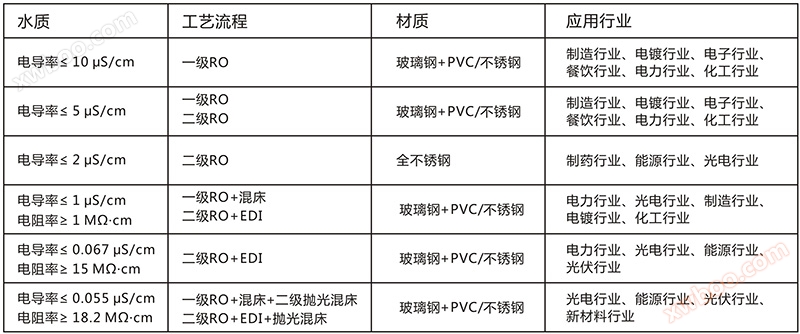

1. Manufacturing industry:Automotive glass, steel, paper, textile, etc
2. Power industry:Boiler thermal power generation cooling cycle, etc
3. Electroplating industry:Coated lighting, cooling, metal plating, LED lights, etc
4. Electronics industry:Electrical chips, circuit boards, microcontrollers, electronic components, etc


Online inquiry
-
Contacts
-
Company
-
Telephone
-
Email
-
WeChat
-
Verification Code
-
Message Content
-