Equipment Overview
The sand table model consists of three layers (including sloping roof), with outdoor control and monitoring points including garage monitoring, garage security, garden monitoring, garden security, garden distance, garden lighting, electric curtains, rain and snow sensing, wind speed sensing, etc. The access control system includes fingerprint sensing, smart doorbell, access control monitoring, etc. The smart home training sandbox will organically combine various devices related to home life, and achieve a new "people-oriented" home life experience through networked comprehensive intelligent control and management. Use touch screen, wireless remote control, telephone, Internet or voice recognition to control household equipment, and perform scene operations at the same time, so that multiple devices can form linkage. Schools can establish a smart home sandbox training system in the laboratory to enable students to understand the comprehensive application of IoT technology and innovate on this basis, cultivating students' innovative application abilities and fully meeting the current demand for cultivating IoT technology talents in universities.

Figure 1 Equipment entity diagram
Product Features
1) The sand table has rich functions and fully reflects the scenarios of daily family life, meeting the needs of students' smart home simulation training. From the intelligent storage of cars to the automatic opening and closing of curtains. For example, when the outdoor weather gets worse, windy or rainy, the electric clothes rack will automatically retract indoors. When someone breaks in outdoors, the corresponding video surveillance will automatically switch to the indoor TV and sound and light alarms.
2) Equipped with an open-source tablet, users can log in to the open-source tablet client interface and selectively control any scene in the smart home sandbox.
3) Covering the most widely used wired and wireless communication methods, including WiFi, Zigbee, BT, IPV6, infrared, etc.
4) Breaking the relatively closed and inconvenient characteristics of traditional smart home systems, the system architecture is very flexible and can be configured with different solutions according to customers' budgets.
5) The kit includes supporting courses such as electronic welding, electronic debugging, electronic product manufacturing, embedded microcontroller applications, IoT engineering training, mobile internet APP development, etc., gradually leading students into the hall of new information technology from shallow to deep. The system opens up all software and hardware design resources.
6) Reliable quality, suitable for repeated experiments in the laboratory
System Architecture Diagram
The smart home sandbox training system adopts a complete IoT technical architecture, namely the perception layer, the transmission layer and the application layer. The front end uses intelligent sensor control nodes to collect various data and control various controlled objects. The transmission layer accesses the wireless Internet gateway through ZIGBEE, WIFI, BT, IPV6 and other networks. The wireless Internet gateway processes various data transmission mobile operating terminals and feeds them back to the controller. The system includes open source control terminals, wireless interconnection gateways, acquisition and control sensor nodes, and intelligent video services. The software and hardware design resources can be opened for teaching and scientific research. The devices used in the system include sensors that support various communication protocols, infrared sensors, indoor monitoring cameras, electrical controllers, electric curtains, electric drying racks, intelligent access control, background speakers, televisions, and other controlled analog devices.


Figure 2 System architecture diagram
Introduction to Comprehensive Project Cases
Project 1: Homecoming Scene
Scenario introduction: When simulating a user returning home, the access control system automatically recognizes their identity and the garage door slowly opens. The home scene starts, the curtains slowly open, and the lights automatically adjust to a comfortable brightness. At this point, the user's favorite TV program has also been turned on.
Equipment involved: smart garage, smart curtains, fingerprint sensors, lighting, TV, etc
Experimental principle: Intelligent sensors are used to control nodes to collect various data and control various controlled objects. By opening the smart home control system, relevant operation pages can be seen, and the home status and control pages can be accessed to open garage doors, doors, televisions, and lights.

Project 2: Leaving Home Scene
Scenario introduction: Simulate when the user leaves home, all electrical facilities except for the refrigerator are turned off, curtains are slowly pulled up, doors and windows automatically close, the security system automatically opens, and the monitoring equipment is turned on. Every corner of the home is under strict monitoring and defense. When someone breaks in outdoors, the corresponding video surveillance automatically switches to the indoor TV and sound and light alarms.
Equipment involved: terminal control system, lighting, curtains, access control cameras, garden surveillance, garden security, sound and light alarms, etc
Experiment principle: The transmission layer accesses the wireless Internet gateway through ZIGBEE, WIFI, BT, IPV6 and other networks, and the wireless Internet gateway processes various data transmission mobile operating terminals and feeds them back to the controller. Students simulate corresponding scenarios by controlling devices such as tablets, mobile phones, etc. through terminals.

Project 3: Adverse Weather Scenarios
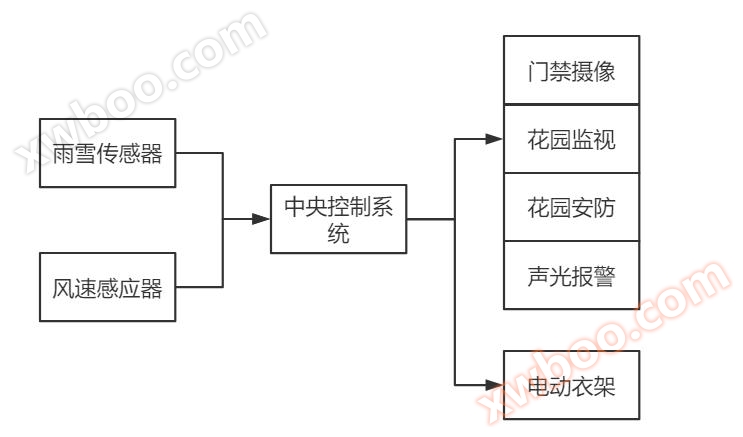
Scenario introduction: Simulate when the user is not at home and it is windy or rainy outdoors, the electric clothes rack will automatically retract indoors. In adverse weather conditions with frequent dangers, the security system will be activated. When someone enters, the doors and windows will be promptly closed to prevent outsiders from entering, and the alarm system will be activated.
Equipment involved: rain and snow sensors, wind speed sensors, terminal control systems, electric hangers, access control cameras, garden surveillance, garden security, sound and light alarms.
Principle introduction: Rain and snow sensors, wind speed sensors collect various data, feedback the information to the central control system, activate access control cameras, garden monitoring, garden security, sound and light alarms, and safeguard the safety of users' homes. Retrieve the electric clothes hanger to prevent clothes from getting wet.