
VIP member

ICT-4 intergranular corrosion tester
ICT-4 intergranular corrosion tester
Product details


1、 Intergranular corrosion tester
ThisIntergranular corrosion testerBy adding corrosive reagents, the intergranular corrosion of different materials in this environment is tested at different temperatures.
Intergranular corrosion is a type of localized corrosion. Corrosion that extends inward along the boundary between metal grains.Intergranular corrosion testerMainly due to differences in chemical composition between the surface and interior of grains, as well as the presence of grain boundary impurities or internal stresses.
Intergranular corrosion destroys the bonding between grains, greatly reducing the mechanical strength of the metal. Moreover, after corrosion occurs, the surface of metals and alloys still maintains a certain metallic luster, with no signs of damage visible. However, the bonding force between grains is significantly weakened, and the mechanical properties deteriorate, making it unable to withstand impact, making it a very dangerous form of corrosion.
Usually found in brass, hard aluminum alloys, and some stainless steel and nickel based alloys. The intergranular corrosion of stainless steel welds is a major issue in the chemical industry.
2、 Related standards for intergranular corrosion:
GB/T 4334. (1-5) -2000 Standard Test Method for Susceptibility to intergranular Corrosion of Stainless Steel (Select the corresponding standard according to the sensitivity of different materials)
GB/T 15260-1994 "Standard Test Method for Susceptibility to intergranular Corrosion of Nickel Alloys"
GB/T 21433-2008 "Sensitivity Test for intergranular Corrosion of Stainless Steel Pressure Vessels"
CB/T 3949-2001 "Test Method for intergranular Corrosion of Stainless Steel Welded Joints in Ships"
ASTM G28 - 02(2008) Standard Test Methods for Detecting Susceptibility to Intergranular Corrosion in Wrought, Nickel Rich, Chromium Bearing Alloys ( Chinese name: "Standard test method for checking the intergranular corrosion sensitivity of forged high nickel chromium bearing alloys"
GB/T 7998-2005 "Determination of intergranular corrosion of aluminum alloys"
HG/T 3173-2002 "Test for intergranular corrosion tendency of urea grade ultra-low carbon chromium nickel key austenitic stainless steel"
3、 Test method for intergranular corrosion
The accelerated metal corrosion test method for testing the intergranular corrosion sensitivity of metal materials under specific medium conditions aims to understand whether the chemical composition, heat treatment, and processing technology of the material are reasonable.
The principle is to use various test solutions that can keep the corrosion potential of the metal in a specific range of the constant potential anodic polarization curve, and to accelerate the display of intergranular corrosion by utilizing the significant difference in corrosion current between the metal grains and grain boundaries in this potential range. The intergranular corrosion test methods for stainless steel, aluminum alloys, etc. have been standardized in many countries. Each standard has detailed regulations on the details of the experiment.
| Test method | Test standards | Test cycle | Remarks |
| Stainless steel intergranular corrosion A method |
GB/T |
4 days | Oxalic acid method |
| Stainless steel intergranular corrosion B method | 7 days | Sulfuric acid iron sulfate 120h | |
| Stainless steel intergranular corrosion C method | 13-15 days | Nitric acid method 5 * 48h | |
| Stainless steel intergranular corrosion D method | 4 days | Nitric acid hydrofluoric acid 2 * 2h | |
| Stainless steel intergranular corrosion E-method | 4 days | Sulfuric acid copper sulfate 16h | |
| Nickel based alloy intergranular corrosion A method |
GB/T 15260-1994 |
7 days | Sulfuric acid iron sulfate 120h |
| Nickel based alloy intergranular corrosion B method | 3 (5) days | Copper sulfate copper sulfate 24-hour or 72h | |
| Nickel based alloy intergranular corrosion C method | 10-12 days | Hydrochloric acid method for 168 hours | |
| Nickel based alloy intergranular corrosion D method | 13-15 days | Nitric acid method 5 * 48h |
| Product category | Specification/mm | Sample size/mm | Number of samples produced/piece | ||
| Long | Wide | Thick | |||
| Steel section | / | 30 | 20 | 3-4 | 2 |
| Casting | / | 30 | ≤20 | / | 2 |
| 80-100 | ≤20 | / | 4 | ||
| Welding rod | / | 30 | 10 | / | 2 |
| 80-100 | 10 | / | 2 | ||
| Welding rod for overlay welding | / | 30 | / | / | 2 |
| 80-100 | / | / | 2 | ||
| Welding joints | Single weld seam | 30 | 20 | 3-4 | 2 |
| 80-100 | 20 | 3-4 | 2 | ||
| Cross weld seam | 30 | 20 | 3-4 | 4 | |
| 80-100 | 20-35 | 3-4 | 4 | ||
| Steel plate, strip (flat steel) section steel | Thickness < 4 | 30 | 20 | / | 2 |
| 80-100 | 20 | / | 2 | ||
| Thickness>4 | 30 | 20 | 3-4 | 2 | |
| 80-100 | 20 | 3-4 | 4 | ||
| Steel rod (steel wire) | Diameter ≤ 10 | 30 | / | / | 2 |
| 80-100 | / | / | 2 | ||
| Diameter>10 | 30 | ≤20 | ≤5 | 2 | |
| 80-100 | ≤20 | ≤5 | 2 | ||
| Seamless steel pipe | Outer diameter<5 | 30 | / | / | 2 |
| 80-100 | / | / | 2 | ||
| 15 ≥ Outer diameter ≥ 5 | 30 | / | / | 2 | |
| 80-100 | / | / | 2 | ||
| Outer diameter>15 | 30 | ≤20 | Tube wall < 4mm | 4 | |
| Pipe wall ≥ 4mm | 4 | ||||
| 80-100 | ≤20 | Tube wall < 4mm | 2 | ||
| Pipe wall ≥ 4mm | 4 | ||||
| Welded pipe | Thickness ≤ 4 | 30 | / | Pipe wall thickness | 2 |
| 80-100 | / | Pipe wall thickness | 2 | ||
| Thickness>4 | 30 | / | 3-4 | 4 | |
| 80-100 | / | 3-4 | 4 | ||
Product Features
1. The ICT-4 intergranular corrosion tester meets the testing requirements of the national standard GB/T4334-2008 (including method A).
2. PLC and PID control, the water temperature is always controlled at the set temperature, achieving a long-term corrosion process at the set temperature, and the system is stable and reliable.
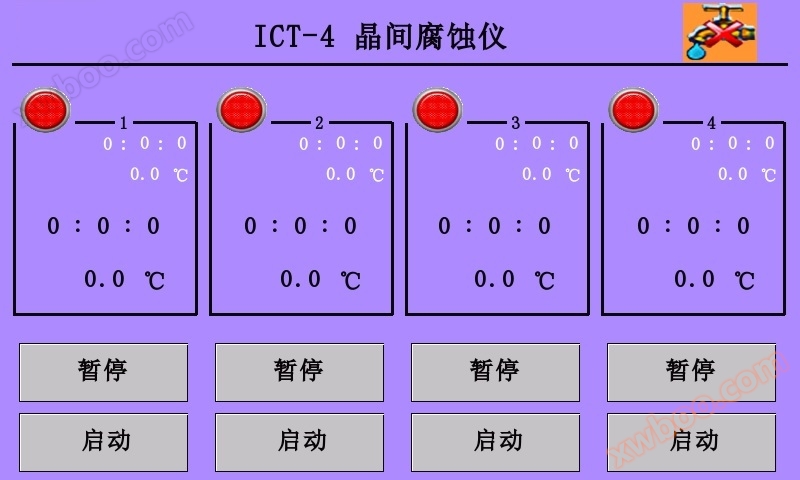
3. The touch screen displays the operation interface, with simple operation and convenient and intuitive parameter settings.
4. It can corrode 4 samples simultaneously (the number of samples can be customized).
5. Without the need for an external water source (optional), the circulating cooling water controls the automatic reflux of hot acid to the beaker, reducing changes in acid concentration.
6. When the cooling water is insufficient or malfunctions, the system automatically alarms and stops heating.
7. If there is a sudden power outage and power is restored, the corrosion test will continue, and the corrosion time will continue to accumulate on the time count before the power outage.
8. The total power of the intergranular corrosion tester is 2000W.
9. The power of each individual workstation is 500W, independently controlled for easy operation.
10. Generally set at around 280 ℃ -320 ℃, the solution will boil and then begin to cool down. The solution should remain boiling until 240 ℃ -260 ℃, with a maximum temperature of 400 ℃.
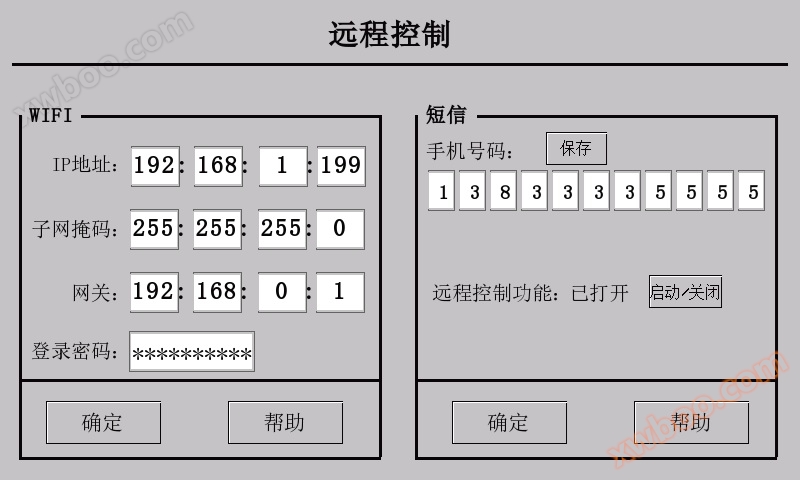
Remote mobile WiFi real-time monitoring (optional), no need to be on duty
Remote mobile SMS monitoring (optional), no need to be on duty
Acid mist treatment cabinet (optional)
to configure
| Name | Specifications | Unit | Quantity |
| The following accessories are the ICT-4 intergranular corrosion tester | |||
| Heater | Four workstations | Set up | 1 |
| Controller | Equipped with water cut-off alarm function | Set up | 1 |
| Beaker | 1000ml | A | 4 |
| Condenser tube device | 50 # Grinding Mouth * 450 | A | 4 |
| Iron frame platform | Iron rod L=60cm, iron plate size 21cm * 13cm | Set up | 4 |
| Bottle clamp | Length 24cm, maximum opening 6.5cm | A | 8 |
| Cross clamp | 2.5cm, reduced total length 8cm | A | 8 |
| Water pipe | 6-pinute 5-meter connector kit | Set up | 1 |
| Throat clamp | 6-12 | A | 4 |
| Latex tube | 6mm*9mm | Package | 1 |
| Tweezers | 30cm round head | A | 1 |
| Raw material belt | Volume | 1 | |
| Power cord | Root | 1 | |
| Technical documents | (1) 1 copy of product manual (2) and 1 copy of product qualification certificate | ||
| The following accessories are for the intergranular corrosion analyzer sensitization test - Method A ICT-A | |||
| Switching power supply | DP3020(30V20A)-600W | A | 1 |
| Stainless steel measuring cup | 1000ML | A | 1 |
| Crocodile clip testing line | 1.5 meters long | Root | 1 |
| Crocodile clip | A | 2 | |
| Iron frame platform | Iron rod L=60cm, iron plate size 21cm * 13cm | Set up | 1 |
| Bottle clamp | Length 24cm, maximum opening 6.5cm | A | 1 |
| Cross clamp | 2.5cm, reduced total length 8cm | A | 1 |
Standard configuration
Select accessories
Automatic Circulating Water System ICT-W
No need for external water source, automatic control of water temperature, automatic detection of water volume, no water shutdown and alarm, more stable test
Remote monitoring system
Remote monitoring of device operation using mobile phones in a network environment
Acid mist treatment cabinet
The cabinet is equipped with an acid mist detection device. When acid mist overflows, an automatic acid mist treatment system is activated, and the filtered air of the acid mist is discharged outdoors
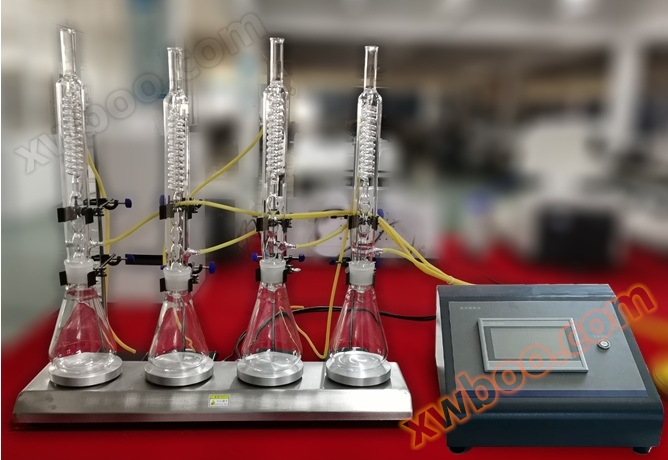
4、 Inter Crystal Corrosion Equipment ICT-4 Product Description
The ICT-4 intergranular corrosion equipment is a unique device specifically designed for intergranular corrosion of specimens, consisting of a heating section, a control section, and a cooling section. This set of equipment consists of four heating bases, which can simultaneously heat four beakers, and the temperature can be freely set through the control part. After cooling, water vapor can automatically reflux back into the beaker, thereby reducing the concentration changes of reagents caused by water vapor evaporation. When working, the sample can be processed and placed in a beaker according to the above standards. Prepare reagents that meet the standard requirements, adjust the temperature to the specified temperature, heat for the specified time, and then remove the sample.
The temperature control system adopts a PID control system to control the water temperature at the set temperature, in order to achieve long-term corrosion process at this temperature.
Temperature controller adjustment range: 0~400 ℃;
Delay time adjustment range: 1m~99h99m;
The configuration list of ICT-4 intergranular corrosion equipment is as follows:
1. 4 heating bases, 500w
2. Four 1000mL specialized triangular beakers (inner diameter 40mm)
3. Four 400mm reflux condensers are provided as accessories
4. 1 set of 4-channel controller for individual temperature control
5. 1 set of specialized tools
5、 Equipment working environment
1. On site laboratory supporting environment
2. Equipment environmental atmospheric pressure: 86.0-106.0Kpa
3. Equipment environment air humidity:< 85%RH
6、 After sales service and quality assurance:
Respond within 24 hours after a malfunction occurs. The seller will provide professional on-site services to ensure the stable operation of the equipment and offer comprehensive technical support and training to users at any time. For the questions raised by users, the seller ensures a clear response and resolution as soon as possible.
The quality assurance period for the above-mentioned equipment is one year from the date of signing the final acceptance report by both parties
During the warranty period, if the product malfunctions due to quality issues, the seller will provide free repair or replacement of components. If the product malfunctions due to human factors, the seller will charge a certain amount of component cost fees to the end user based on the principle of the original factory
After the warranty period, the seller will conduct regular on-site visits to users to track the long-term after-sales service of the above-mentioned equipment, to ensure that it can meet the needs of production work.
Lifetime provision of spare parts and high-quality services.
7、 Technical data
1. The supplier shall provide the purchaser with a factory quality verification and warranty certificate along with the equipment, and the accompanying technical data should be complete.
2. The supplier shall provide a Chinese manual to the purchaser along with the equipment, including installation, operation, maintenance, and repair manuals.
8、 Quality assurance period
The equipment warranty period is one year. During the warranty period, if there are quality issues with the equipment, the supplier shall provide labor and spare parts free of charge
2. After sales service
2.1 The supplier guarantees to provide high-quality services to the demander. Upon receiving the demander's fault information, the supplier shall respond to maintenance inquiries within 4 hours and eliminate the fault within 3-5 working days before delivery for use;
2.2 After the expiration of the equipment warranty period, technical support and discounted spare parts supply can still be provided, and only component cost fees will be charged for repairs.
Online inquiry
-
Contacts
-
Company
-
Telephone
-
Email
-
WeChat
-
Verification Code
-
Message Content
-