
VIP member
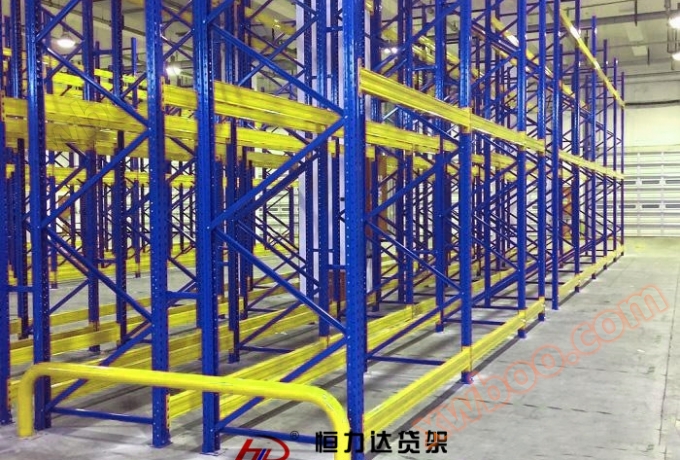
Double depth shelving
Double depth pallet shelving, also known as double depth shelving, is derived from ordinary crossbeam shelving. It is a dense shelving storage system,
Product details
Double Deep Pallet RackingIt is a type of shelf derived from the beam type pallet rack; The goods are placed in double positions along the depth direction of the shelf, and a forward moving forklift with telescopic forks must be used to access the goods. Under the same site conditions, the storage capacity can be increased by up to 30%, but only 50% of the goods can be accessed immediately.
Double depth pallet shelves can increase storage capacity by 75% to 100% compared to ordinary crossbeam shelves, but there are also some shortcomings. The storage and retrieval of goods in the back row can only be carried out after the corresponding goods in the front row have been removed or relocated. Double depth shelves cannot achieve first in first out, only first in first out. To improve warehouse utilization, it is generally necessary to consider storing the rear shelves first and then the front shelves when storing inventory. Double depth crossbeam shelves usually require the installation of 2 forklift rails at each pallet position to guide the entry of fork teeth for convenient storage and retrieval of goods.

Characteristics of Double Depth Tray Shelves:
-
The height of the crossbeam is relatively low, and the working height in the flat warehouse can reach about 8 meters;
-
Medium inventory turnover rate, providing 50% selectivity;
-
Suitable for warehouses with low pick-up rates, with a ground utilization rate of up to 42%;
-
The double depth shelving structure is simple, with high utilization rate and large storage capacity for goods;
-
The inventory level is twice as high as that of ordinary crossbeam shelves, which can effectively alleviate storage pressure;
-
Special forklifts are required for operation;
-
The width of the forklift aisle needs to be around 3.3 meters;
-
The number of channels decreases, the number of shelf arrangements increases, and the storage capacity of goods is twice that of ordinary crossbeam shelves;
-
Special forward moving stacker cranes (some referred to as three-way forklifts) are used for operations in high-level warehouses, and the stacker crane forks generally use 5-level forks;
-
Goods can only be accessed and stored after the corresponding goods in the front row have been removed or moved. It is difficult to achieve first in, first out for shelves. To improve warehouse utilization, it is generally necessary to consider storing the back row shelves first and then the front row shelves when storing inventory;
-
When picking up goods, try to pick up all the goods in the front and back rows at once. If they cannot be picked up at once, it may affect the warehouse utilization or storage efficiency;
-
The construction cost of each storage location is the lowest among all the rack systems in the three-dimensional warehouse system.
Online inquiry
-
Contacts
-
Company
-
Telephone
-
Email
-
WeChat
-
Verification Code
-
Message Content
-