
VIP member
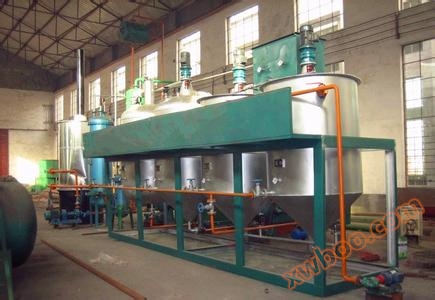
Product details
The main purpose of refining corn oil is to remove impurities and produce corn embryo oil that meets the oil standard requirements. The oil obtained during the oil production process is a mixture of triglycerides containing other impurities. If crude oil is leached and contains trace amounts of solvents, the mechanical impurities in the crude oil obtained by pressing method need to be removed from the non triglyceride components mentioned above.
Corn oil must go through processes such as sedimentation, filtration, hydration, and deodorization. Sometimes it is necessary to further refine according to requirements, such as alkali refining, decolorization, dewaxing, and pollutant removal treatment. Especially when pollution is found, it must be treated to avoid harm to the human body.
The conventional oil pressing, pre pressing leaching, and extraction methods for refining corn germ oil, as well as the CO2 supercritical fluid extraction method for corn germ oil, can be used as finished oil packaging as long as the corn germ is fresh, has low peroxide and acid values, and the raw material is in good condition. After CO2 removal by supercritical extraction, the corn germ oil has high natural vitamin E content, precipitation, filtration, and other indicators meet the requirements of edible oil indicators. If the moisture content is high, it can be achieved through drying treatment to meet the requirements. The refining of crude oil here mainly focuses on the refining of corn oil.
Corn oil refining process flow:
Whether using an oil press for pressing or direct leaching and pre pressing leaching, the equipment used in the refining process is basically the same.
Crude oil | - general refining process - filtration - hydration - deodorization - refined corn oil
Alternatively, crude oil | - special refining process (alkali refining decolorization dewaxing impurity removal) - refined corn oil
(1) Precipitation:
1. The principle of precipitation is to separate oil and impurities based on their different densities. After standing for a certain period of time, mechanical impurities and water with a higher density than the oil can settle to the bottom of the crude oil. In addition, it can also separate a small amount of suspended impurities as well as a small amount of phospholipids, proteins, and starch paste.
2. Equipment and operation used: Sedimentation is carried out using oil drums, oil tanks, or mailboxes, whose size can be determined according to the processing capacity. Inject the oil that needs to be precipitated into the container and observe its precipitation situation. When it is considered that the precipitation is good, the oil and impurities can be separated.
3. Influencing factors: The precipitation effect is mainly affected by temperature and time. High temperature and long time result in good precipitation effect; Low temperature and short time result in poor precipitation effect. According to local experience, the temperature is high in summer, and after three days, it basically settles well; In winter, if the temperature remains above 0 degrees Celsius, the sedimentation time should not be less than 7 days. In spring and autumn, it can be adjusted according to the temperature situation.
(2) Filtering
1. Filtering principle: Filtering is the process of allowing oil to pass through the filter cloth under the pressure of a pump, while impurities remain between the filter cloths. Filtering can reduce mechanical impurities to trace levels and also remove some wax.
2. Filter press equipment and operation: Common filter press equipment includes different models of plate frame oil filters and matched gear pumps.
3. Technical characteristics of filter press: Regardless of the type of filter press, it uses pressure to filter crude oil through the filter cloth, allowing impurities and wax to remain on the filter cloth, while oil is collected and retained through the filter cloth, thus achieving the purpose of filtration. Filtering is an intermittent process. First, install the filter cloth, then start filtering. When the pressure reaches the required level, stop filtering, loosen the filter cloth, clean the oil residue, and complete one filtration cycle.
4. Influencing factors: The filtration effect is related to the filtration speed and viscosity of the oil. An increase in crude oil temperature will cause a decrease in viscosity and an increase in filtration speed. But as the temperature increases, it will increase the solubility of oil, proteins, and mucus, thereby affecting the filtration effect. According to experience, filtering corn oil at a temperature below 25 degrees is more effective.
(3) Hydration
1. Hydration principle: Hydration is the process of separating and treating impurities such as phospholipids, proteins, and mucus in oil by adding water and heating it. It is believed that phospholipids will expand after absorbing water, causing an increase in volume. Proteins, mucus, and other impurities bound to phospholipids will sink and precipitate due to an increase in relative density.
2. Hydration equipment and its process operation: Hydration equipment mainly includes hydration pots and dehydration pots after hydration. The two have similar structures, both being cylindrical iron pots with conical bottoms. There are water and oil injection pipes on the upper part, stirring blades in the middle, a shaking head pipe for oil in the pot, and an outlet for impurities at the bottom.
Hydration can be carried out using either high-temperature or low-temperature hydration methods.
The high-temperature hydration method involves heating corn oil with indirect steam to around 80 degrees Celsius, and then adding boiling water. There are two types of boiling water: one is 5% saline solution, which adds 2% -3% of the amount of oil; Another way is to directly heat water. No matter what water is added, the corn oil should be heated to around 98 degrees Celsius before stopping stirring, and then allowed to settle. The clear oil should be poured into another pot and heated to around 105 degrees Celsius to remove moisture. After cooling, the essential oil can be obtained.
When using low-temperature hydration, 100kg of crude oil is mixed with 4kg of water. Before adding water, the crude oil is first stirred. For example, when the stirring blade is 60r/min, it can be stirred for 10 minutes. Water is added while stirring. After adding water in proportion, continue stirring for 20 minutes, and then precipitate for 24 hours to allow impurities such as phospholipids to precipitate and settle.
No matter which method is used for hydration, it is necessary to strengthen precipitation and filtration before hydration, otherwise the powder content will be high, which will affect the hydration effect. The hydration temperature should be controlled according to the amount of water added. During operation, it is necessary to control that as the amount of water added increases, the temperature increases accordingly, and as the amount of water added decreases, the temperature decreases. The amount of water added should also be controlled appropriately, as adding too much water can easily cause emulsification. Similarly, the time and method of stirring are also factors that affect hydration. At present, there is not much experience in the field of corn oil-water conversion, and it is necessary to explore the rules and strengthen operations in practice to ensure the hydration effect.
(4) Deodorization
① The commonly used principle for deodorization is vacuum deodorization, which involves passing steam through corn germ oil and then using a vacuum pump to remove low boiling point odorous impurities (such as aldehydes, ketones, and free fatty acids) and solvent odors from the oil. Due to the presence of water vapor in the extracted gas, it also needs to pass through a gas-liquid separator and an atmospheric condenser to separate water droplets, allowing air and non condensable gases to be discharged, thereby achieving the goal of removing odors.
Hydration or alkali refining treatment before deodorization can better remove gum and impurities from crude oil, creating favorable conditions for the next deodorization process and facilitating the removal of residual solvents and other odors.
② This is a process that can be used for both alkali refining or hydration, as well as deodorization. Corn oil is first pumped with alkali. Due to the action of the vacuum pump, a vacuum is created inside the deodorization pot for vacuum deodorization. The emitted odor and direct water vapor sprayed in are continuously extracted with the air and added to the gas-liquid separator. The gas-liquid separator is an external rotary brake cylinder that separates a portion of the condensed water and solvent from the gas. The non condensable part of the gas then enters the atmospheric condenser, and a portion of the condensable gas is cooled by the cold water poured in from the upper part and condensed. It flows into the water seal pool along the pressure pipe 7, and the non condensable gas is drawn from the upper outlet of the condenser to the gas-liquid separator for further separation of separable water droplets. The air and non condensable gas are finally discharged by the vacuum pump.
③ The working process of the main process equipment structure deodorization pot is that after the crude oil to be deodorized enters the pot, it is heated by a snake tube through indirect steam heating, and direct steam is sprayed into it through a steam nozzle. Then, through the vacuum effect, the odor and water vapor are sucked out together, thus carrying out the deodorization process.
Structure of atmospheric condenser
The atmospheric condenser is a major equipment in the deodorization process. It can separate the condensable part of the extracted gas from the air and non condensable part.
The working process of the atmospheric condenser is that the gas extracted from the deodorization pot enters through the inlet pipe, and the gas encounters water that enters through the inlet pipe and overflows from the water spray plate, causing the condensable part of the gas to flow out through the lower outlet pipe, while air and non condensable gases are extracted from the upper part. The pressure pipe is directly sealed in the water tank by the atmospheric condenser. The pressure head generated by the liquid column in the pressure tube is equivalent to the difference between the atmospheric pressure outside and the pressure in the condenser. The height of the air pressure pipe must be at least 10m above the water level of the water seal pool.
Vacuum pump is the main equipment for vacuum deodorization. Currently, the W-type vacuum pump is commonly used, and can be selected according to the processing capacity during production.
④ In the operation of vacuum deodorization, it is necessary to evacuate when the vacuum degree is greater than or equal to 1.0MPa and the oil temperature is greater than 140 ℃. The vacuuming time should not be less than 3-4 hours. The superheated steam pressure should reach 1.0MPa, and jet should start when the oil temperature reaches 100 ℃. For corn oil extracted directly and pre squeezed, it is necessary to strengthen the operation to completely remove the solvent odor.
Online inquiry
-
Contacts
-
Company
-
Telephone
-
Email
-
WeChat
-
Verification Code
-
Message Content
-