
VIP member

CPICS plankton color continuous imaging classification system
The Continuous Color Imaging and Classification System for Underwater Plankton (CPICS) produced by Coastal Ocean Vision in the United States is the wo
Product details
Introduction:

The Continuous Color Imaging and Classification System for Underwater Plankton (CPICS) produced by Coastal Ocean Vision in the United States is the world's most advanced underwater microscopy imaging instrument, used for continuous color imaging and classification of tiny phytoplankton, zooplankton, and other particulate matter in seawater, freshwater, and laboratory samples. CPICS adopts advanced dark field microscopy imaging technology (Darkfield Illumination), which can capture plankton features as small as 40 μ m and as large as 1.2cm. The scientific community has discovered that color images are crucial for high-precision classification of organisms, while also providing important physiological information, such as pigments left in the body after consuming certain phytoplankton. CPICS has an open field of view and can directly image underwater. Aquatic organisms are in a state of free movement, so it can fully capture the subtle biological structure and primitive living conditions of planktonic animals, such as predation processes.
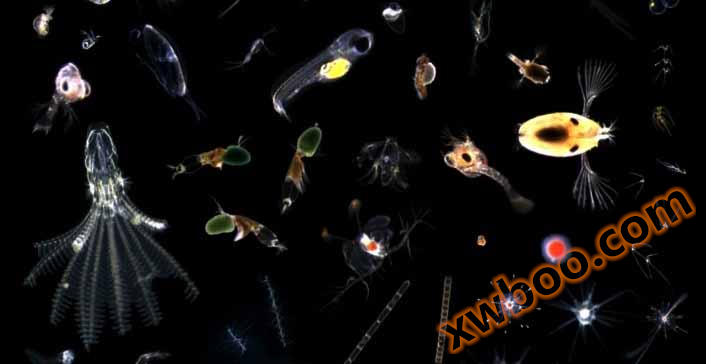
ROIs obtained by CPICS
CPICS application:
1. Scan planktonic animals, phytoplankton, and small particulate matter;
2. Continuous color imaging, automatic classification, counting, and time series abundance analysis;
3. Oceans, lakes, rivers, reservoirs, and drinking water sources;
4. Can be installed on: profiling instrument, multi bottle water sampler, underwater observation network, buoy, submersible marker, variable water layer trailer AUV、ROV、 Manned submersible, deep-sea lander;
5. Scientific research and environmental monitoring.
Working principle of CPICS:
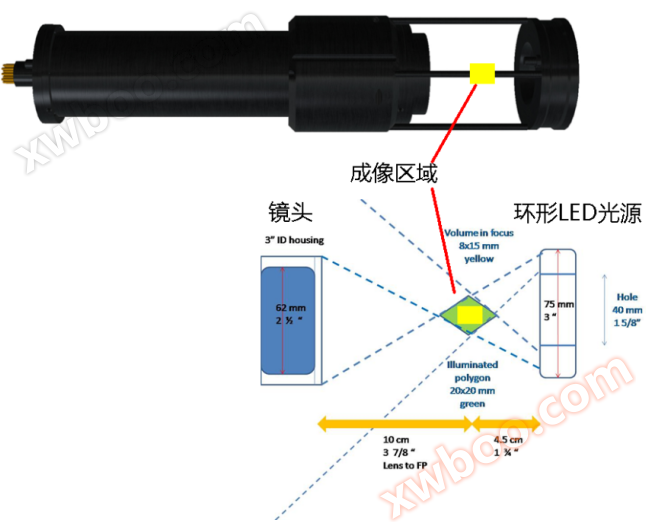
CPICS uses dark field microscopy imaging technology. The high output circular LED light source array can generate intersecting conical beams during operation, which converge at the focal point of the lens. During CPICS operation, the LED light source fully illuminates the focused shooting area, and only illuminates that area. Particles in front and behind this area are not illuminated by the beam, only refracted and reflected light enter the camera lens. Since there is no direct light entering the lens, high contrast, high-resolution color images can be generated with a black background in the photo. This is different from bright field imaging, where when the magnification is low (<40x), the dark field illumination method of CPICS is significantly better than that of bright field.
In addition, standard CPICS is equipped with a telecentric lens to capture images of organisms in the focal area. This lens can maintain a constant magnification for all living organisms within the focal area. The biggest advantage of a telecentric lens is that it can maintain a constant magnification for objects that are not on the same plane, eliminating differences in magnification caused by inconsistent approach distances between the measured object and the lens. Therefore, CPICS can maintain the same magnification throughout the entire depth of field (DOF) while capturing all living organisms within the illuminated focused sampling volume (FOV field of view).
Main features of CPICS:
1. Advanced imaging technology: CPICS adopts advanced dark field microscopy imaging technology (Darkfield Illumination), which can generate higher contrast and higher resolution color images compared to traditional bright field imaging and holographic imaging;
2. High performance light source: CPICS is equipped with a high output, high lifespan LED ring array, which fully illuminates the focusing area without producing any shadows;
3. High performance lens: CPICS is equipped with a telecentric lens, which can maintain a constant magnification within the panoramic depth range (DOF) and take photos of all living organisms within the focused sampling volume (FOV field of view);
4. CPICS has an open flow area of up to 1.5L, which allows for direct imaging underwater without the need for laboratory instruments or flow cytometers to extract water samples for photography. It does not disrupt the free swimming state of aquatic organisms, allowing for the complete capture of the fine biological structure and primitive living conditions of planktonic animals;
5. High degree of automation: CPICS is equipped with a high-performance image processor and large capacity memory, which can automatically extract, process, and save ROI on-site. In addition, CPICS has WiFi function, which allows direct connection to WiFi through a computer without opening the instrument casing, and enables various parameter settings for CPICS;
6. High flexibility: Multiple configurations and magnification lenses are available for users to choose from, allowing for high-quality imaging and photography of plankton of interest size. For example: ultra micro, micro, small, medium or large planktonic organisms;
7. Wide applicable sea area: not only suitable for clear water bodies, but also for high turbidity water bodies (greater than 100NTU);
8. Wide range of applications: Not only can it be used for fixed-point long-term observation in underwater observation networks, but it can also be used for CTD, towing, anchoring, profile measurement, or mounted on unmanned underwater vehicles (ROVs, AUVs, Gliders, etc.);
9. Browser based classification software: ROI Manage manual and ROI Class automatic classification software run on the servers of COV manufacturers in the United States. The feature extraction and classification decoding programs can be automatically updated, eliminating a lot of maintenance work for users.
As long as users can access the internet, they can log in to classification software through a browser to perform classification and data display;
10. Another advantage of CPICS is its automatic classification of plankton and particulate matter. Combined with other sensors on our OceanCube seafloor multi-sensor platform and ROI-CLASS analysis software, CPICS allows scientists to better observe and understand the ecology and physiology of aquatic organisms, such as the spatial distribution of different plankton species under different environmental parameters (water temperature, depth, salinity, light, dissolved oxygen, etc.), as well as their changes over time.
Technical indicators of CPICS:
1. Lighting:
Light source: High output LED ring array
Exposure: minimum 10 μ s
2. Maximum withstand voltage level:
CPICS-1000-e: 1000m (Derlin shell)
CPICS-6000-e: 6000m (titanium alloy)
3. Photography system
Color resolution: 24 bits
Image resolution: 6M pixels (2736 × 2192)
Fastest frame rate: 10 fps (10 frames per second)
4. Underwater target acquisition and storage
Camera control parameters: exposure, frame rate
Target extraction: focal length and critical size values
Embedded processors: NVIDIA TX2
5. Image analysis (requires purchase of ROI-CLASS software)
Biological classification: taxonomic unit level (e.g. copepod)
Animal Copepod
Hardware: Running on the manufacturer's cloud server or desktop image processing and classification and storage unit (with 2TB storage hard drive)
6. Data communication
Port: Ethernet, WiFi
Or RS232 (other sensors)
7. Power supply:
DC input: 12VDC (powered by cable or battery)
Current power: 7W
Standard battery pack lifespan: approximately 6 hours (continuous operation)
Test cable: customizable by users (including 1m long)
Water tight joint: SubConn DBH13M
8. Size: Length x Diameter: 74cm x 12cm
9. Weight: 5.4kg in air, 4.3kg in water

CPICS Case Picture

CPICS installed on the underwater observation network platform (remotely controlled through fiber optics, real-time transmission of image data to shore)

CPICS installed in HabCam V5 underwater towed stereo imaging scanning system
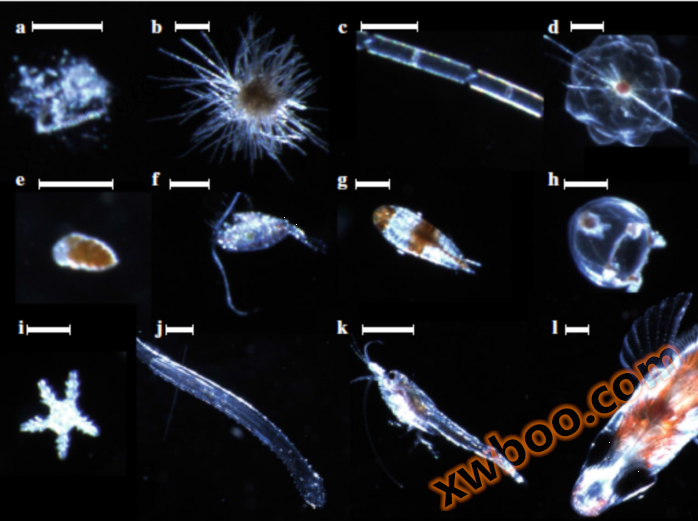
Example of Image Classification Obtained by CPICS
11 categories of images: a sea snow, b diatoms, c diatoms, d radiolarians, e foraminifera, f copepods, g isopods, h echinoderms, other planktonic animals (i adult starfish, j crocodiles), k sugar shrimp, l fish. The size bar represents 500 μ m, and j, k, and l represent 1000 μ m.
Online inquiry
-
Contacts
-
Company
-
Telephone
-
Email
-
WeChat
-
Verification Code
-
Message Content
-