
VIP member

BRIZO Wave Sensor
Xeos Technologies Inc., founded in 2004, is committed to combining diverse and mature technologies to develop world leading wireless telemetry product
Product details
Xeos Company Profile:

Xeos Technologies Inc., founded in 2004, is committed to combining diverse and mature technologies to develop world leading wireless telemetry products. The three founders of Xeos have over 60 years of combined experience in electronic engineering, mechanical engineering, software development, and manufacturing. Xeos' products include deep-sea beacons, surface oil spill tracking systems, and ground perimeter monitoring systems. Xeos is also an Iridium value-added service agent and can provide contracted technical services in addition to their standard product line. All of these traits have brought success to Xeos in four areas: communication, ocean equipment recycling, remote monitoring, and protection.
Xeos' main beacon products:
1. MELO:Iridium beacon on the sea surface, bidirectional iridium communication+GPS, with a sturdy anti UV shell, mainly used on various sea surface buoys and other floating objects, with a monitoring circle function to diagnose whether the buoy is anchored. A 3-hour transmission interval can work continuously for 2 years.
2. ROVER:Iridium satellite beacon on the sea surface, bidirectional Iridium communication+GPS, with a sturdy UV (ultraviolet) resistant shell. The beacon has two Iridium/GPS antennas located at the top and bottom of the beacon, mainly used on various sea buoys and other floating objects, especially suitable for use in harsh environments. Even if the buoy or floating object overturns, the beacon can continuously send location information. The 3-hour transmission interval can work continuously for 2 years.
3. OSKER&ROBY:Surface ocean current tracking beacon, bidirectional iridium satellite communication+GPS, beacon with 2 iridium/GPS antennas, mainly used for tracking oil spills on the sea surface. Among them, OSKER can be used alone or as a group of 5-10 for aerial deployment to monitor a certain area. It can work continuously for about 181 days every 3 hours. ROBY beacon is equipped with a floating snap ring collar, which can work continuously for 2 years with a transmission interval of 3 hours.
4. KILO:Underwater Iridium Satellite Beacon, operating at a depth of 2500m, with bidirectional Iridium communication and GPS. It is mainly used for anchor based submersible markers, seabed foundations, underwater towed vehicles, AUVs, ROVs, and other underwater instruments and systems. Can work continuously underwater for 1 year and above water for 90 days.
5. SABLE:Underwater Iridium Satellite Beacon, titanium alloy shell, working depth of 5000m, bidirectional Iridium satellite communication+GPS, mainly used in anchor based submersible markers, seabed bases, deep-sea landers, underwater towed bodies, AUVs, ROVs, and other underwater instruments and systems. Can work continuously underwater for 2 years and underwater for 1 year.
6. XMi-11K&XMi-11K-RH:Underwater Iridium Satellite Beacon, titanium alloy shell, working depth of 11000m, bidirectional Iridium satellite communication+GPS, mainly used for anchor based submersible markers, seabed bases, deep-sea landers, underwater towed bodies, AUVs, ROVs, and other underwater instruments and systems. Can work continuously underwater for 1 year and above water for 90 days. Among them, XMi-11K-RH has a split structure.
7. XMF-11K&XMF-11K-RH:Underwater LED light beacon, titanium alloy shell, working depth of 11000m, equipped with ultra bright LED flash, mainly used in anchor based submersible markers, seabed foundations, deep-sea landing vehicles, underwater towed bodies, AUVs, ROVs, and other underwater instruments and systems. This beacon is very suitable for searching for water equipment at night. Can flash continuously for 60 days. The XMF-11K-RH is a split structure.
8. XMB-11K&XMB-11K-RH:Underwater radio beacon, working at a depth of 11000m, equipped with a radio signal transmitting antenna, mainly used in anchor based submersible beacons, seabed bases, deep-sea landers, underwater towed vehicles, AUVs, ROVs, and other underwater instruments and systems. The farthest signal transmission distance is 12 kilometers.
9. XMA-11K&XMA-11K-RH:Underwater Argos beacon, working at a depth of 11000m, Argos communication+GPS, mainly used for anchor based submersible markers, seabed bases, deep-sea landers, underwater towed vehicles, AUVs, ROVs, and other underwater instruments and systems.
10. APOLLO:Underwater LED Iridium beacon, working at a depth of 11000m, with bidirectional Iridium communication+GPS+LED flashing. Apollo beacon combines ultra bright LED flashing with Iridium communication function, making it easy to search and retrieve water equipment both day and night. Mainly used in anchor based submersible markers, seabed foundations, deep-sea landers, underwater towed vehicles, AUVs, ROVs, and other underwater instruments and systems. This beacon can be deployed underwater for up to 10 years.
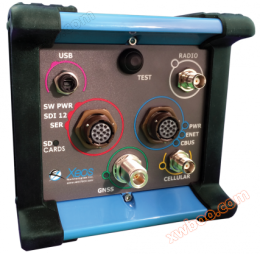
11. BRIZO:Wave sensors based on GPS technology are mainly applied to surface buoys and can be added to existing ocean buoys, drifting buoys, or unmanned ships for wave measurement, as well as real-time data collection and transmission.
BRIZO Wave Sensor
BRIZO Introduction:
BRIZO is a wave sensor based on GPS technology. It can be easily added to existing ocean buoys, drifting buoys, or unmanned ships, expanding the functionality of the user platform for wave measurement and real-time data collection and transmission.

Main features of BRIZO:
1. Easy to install on existing observation platforms
2. Using GPS technology principles to measure waves
3. Simultaneously measure wave height and wave direction
4. Built in data collector
5. Low power consumption, suitable for long-term deployment
6. Users can choose the remote communication module for data transmission
BRIZO remote transmission options:
1. Iridium SBD communication module
2. Celluar cellular wireless transmission module
3. UHF wireless communication
Need to add a wave sensor to your equipment?
Do you need to add wave sensors to your existing platform?
BRIZO Technical Parameters
Data output:
Wave parameters: maximum wave height, significant wave height, peak period, peak wave direction, peak diffusivity.
Wave spectrum: Wave directional spectrum, 32/64/128 bins
(Energy/Fourier coefficient vs. frequency)
Data output rate: user configurable
Electrical specifications:
Input voltage: 9-27VDC
Power consumption: 0.75-1.3W (depending on settings)
Working temperature:- 40-60 ° C (standard)
Supports various GNSS systems and choke type external antennas
GNSS:
Supports GPS, GLONASS, and Beidou systems
Dual band, L1/L2 (optional L5)
Channel 136
Communication (internal options):
Iridium 9523 module (RUDICS and SBD);
Cellular wireless (GPRS, CDMA, HSPA+, LTE, SMS);
XBee Pro900HP, 24dBm/250mW transmission power/Mesh Network
Communication (standard):
Serial port, 2 RS232/485
SDI-12
USB: Full speed USB port for instrument configuration and diagnosis
Data collection:
Collection frequency: default 2Hz
Wave period range: 0.64-0.030Hz (1.56-33.33s)
Wave sampling time and calculation period: user configurable
Accuracy:
Wave height: better than 1%
Wave direction: better than 1%, 3 °
Data storage:
1 built-in 4G SD card, optional remote communication module
Online inquiry
-
Contacts
-
Company
-
Telephone
-
Email
-
WeChat
-
Verification Code
-
Message Content
-