
VIP member
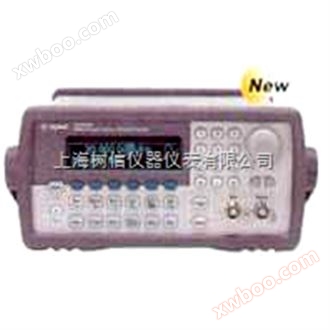
Arbitrary Function Generator 33220A Agilent Arbitrary Function Generator 33220A
Agilent 33220A Signal Generator Product Features: 20MHz sine and square wave pulses, oblique waves, triangular waves, noise and DC waveforms 14 bit, 5
Product details
| brand | Agilent/Agilent |
|---|
the United StatesAgilent Arbitrary Function Generator 33220AAgilent33220A
10mVpp to 10Vpp seedling range
A graphical interface can visually verify signal settings
Connected via USB, GPIB, and LAN
Waveforms of various functions with excellent performance
The Agilent 33220A function/arbitrary waveform generator uses direct digital synthesis (DDS) technology to generate stable, accurate, pure, and low distortion sine output signals. It can also provide square waves up to 20MHz with rapid rise and fall, as well as linear ramp waves up to 200KHz.
Pulse edge signal
33220A can generate variable edge time pulses up to 5MHz. The 33220A pulse can also have variable periods, pulse widths, and amplitudes, making it an ideal device for various applications that require flexible pulse signals.
Specialized waveform generation
33220A can be used to generate complex specialized waveforms. 33220A has a resolution of 14 bits and a sampling rate of 50MSa/s, allowing for flexible generation of the desired waveform. Four waveforms can be stored in non-volatile memory.
With Agilent IntuiLink arbitrary waveform software, you can easily generate, edit, and download complex waveforms using a waveform editor. You can also use IntuiLink to capture oscilloscope waveforms and send them as output to 33220A
Easy to use features
The front panel of 33220A is easy and user-friendly to operate. With just one or two keys, you can access all the main functions. Knobs or numeric keys can be used to adjust frequency, amplitude, bias, and other parameters. You can even directly input Vpp, Vrms, dBm, or high and low level values. The timing parameters can be input in Hertz (Hz) or seconds.
Internal AM, FM, PM, FSK, and PWM modulation enable the instrument to easily modulate waveforms without the need for a separate modulation source. Linear and logarithmic scanning are also built-in functions, and the scanning rate can be selected within the range of 1ms to 500s. The pulse train mode allows users to select the period of each time segment. GPIB, LAN, and USB interfaces are all standard configurations, and you can also obtain full programming capabilities for SCPI commands.
External Frequency Reference (Option 001)
The 33220A external frequency reference allows you to synchronize with an external 10MHz clock, another 33220A, or Agilent 33250A. Phase adjustment can be performed from the front panel or through a computer interface to achieve precise phase calibration and adjustment.
3-year warranty period
33220A comes with operation and maintenance manuals, quick guides, test data, and a 3-year warranty, all of which can be purchased at a very low price.
Agilent 33220ATechnical parameters of signal generator:
| waveform | |||
| Standard waveform | Sine wave, square wave, oblique wave, triangular wave, pulse, noise, DC | ||
| Built in arbitrary waveform | Index increase, index decrease, negative slope wave Sin(x)x、 Cardiac rhythm wave | ||
| waveform parameters | |||
| sine wave | |||
| frequency range | 1 μ Hz to 20MHz | ||
| Amplitude flatness[1][2] <100KHz 100kHz to 2MHz 2MHz to 20MHz |
(Compared to 1KHz) 0.1dB 0.15dB 0.3dB |
||
|
Oblique wave distortion[2][3] DC至20kHz 20kHz to 100MHz 100kHz to 1MHz 1MHz to 20MHz |
<1Vpp -70dBc -65dBc -50dBc -40dBc |
≥1Vpp -70dBc -60dBc -45dBc -35dBc |
|
| Total oblique wave distortion[2][3] DC至20kHz |
0.03% |
||
| False wave (non oblique wave)[2][4] DC to 1MHz 1MHz to 20MHz |
-70dBc -70dBc+6dB/multiplier value |
||
| Phase noise (10KHz 偏置) |
-115dBc/Hz, typical value |
||
| square wave | |||
| frequency range | 1 μ Hz to 20MHz | ||
| Rise/fall time | <15ns | ||
| overshoot | 4% | ||
| Variable duty cycle | 20% to 80% (up to 10MHz) 40% to 60% (up to 20NHz) |
||
| Asymmetry (@ 50% duty cycle) | 1% cycle+5ns | ||
| Jitter (RMS) | 300ps+100ppm * cycle | ||
| Diagonal wave, triangular wave | |||
| frequency range | 1 μ Hz to 200kHz | ||
| linearity | <1% peak output | ||
| Variable symmetry | 0.0% to 100.0% | ||
| pulse | |||
| frequency range | 500 μ Hz to 5MHz | ||
| Pulse width (≥ 100mHz) | 20nszui small value 10ns resolution |
||
| Variable along time | <13ns to 100ns | ||
| overshoot Jitter (RMS) |
<2% 300ps+0.1ppm * cycle |
||
| noise | |||
| Bandwidth (-3dB) | 9MHz, typical value | ||
| Arbitrary waveform | |||
| frequency range | 1 μ Hz to 6MHz | ||
| Waveform length | 2 to 64k points | ||
| Amplitude resolution | 14 bits (including symbols) | ||
| sampling rate | 50MSa/s | ||
| Zui small rise/fall time | 35ns, typical value | ||
| linearity | <0.1% peak output | ||
| stabilization time | <250ns, To 0.5% of the final value | ||
| Jitter (RMS) | 6ns+30ppm | ||
| Non-volatile memory | 4 waveforms | ||
| Public indicators | |||
| amplitude | |||
| scope | 10mVpp to 10Vpp, output to 50 Ω 20mVpp to 20Vpp, output to start |
||
| Accuracy (at 1kHz) | ± 1% set value ± 1mVpp | ||
| unit | Vpp,Vrms,dBm | ||
| resolution | 4 people | ||
| DC bias | |||
| Range (peak AC+DC) | ± 5V, output to 50 Ω ± 10V, output to start |
||
| precision[1][2] | ± 2% bias setting value ± 0.5% amplitude ± 2mV |
||
| resolution | 4 people | ||
| Main output | |||
| impedance | 50Ω, 典型值 | ||
| isolation | The maximum value of 42Vpk to ground | ||
| protect | Short circuit protection, automatic disconnection of main output due to overload | ||
| Internal frequency reference | |||
| precision[5] | 10ppm, 90 days 20ppm,1 年 |
||
| External Frequency Reference (Option 001) | |||
| Rear panel input | |||
| Locking range | 10MHz±500Hz | ||
| level | 100mVpp, 至5Vpp | ||
| impedance | Typical value of 1k Ω, AC coupling | ||
| Lock time | <2s | ||
| Rear panel output | |||
| Locking range | 10MHz | ||
| level | 623mVpp(dBm), typical value | ||
| impedance | 50 Ω typical value, AC coupling | ||
| phase offset | |||
| scope | +360 ° to -360 ° | ||
| resolution | 0.001° | ||
| precision | 20ns | ||
| modulation | |||
| AM | |||
| carrier wave | Sine wave, square wave, oblique wave, arbitrary waveform | ||
| source | internal | ||
| Internal modulation | Sine wave, square wave, oblique wave, triangular wave, noise, arbitrary waveform (20mHz to 20MHz) | ||
| depth | 0.01% to 120.0% | ||
| FM | |||
| carrier wave | Sine wave, square wave, oblique wave, arbitrary waveform | ||
| source | internal | ||
| Internal modulation | Sine wave, square wave, oblique wave, triangular wave, noise, arbitrary waveform (2mHz to 20kHz) | ||
| offset | DC to 10MHz | ||
| PM | |||
| carrier wave | Sine wave, square wave, oblique wave, arbitrary waveform | ||
| source | internal | ||
| Internal modulation | Sine wave, square wave, oblique wave, triangular wave, noise, arbitrary waveform (2mHz to 20kHz) | ||
| offset | 0.0 ° to 360 ° | ||
| PWM | |||
| carrier wave | pulse | ||
| source | internal | ||
| Internal modulation | Sine wave, square wave, oblique wave, triangular wave, noise, arbitrary waveform (2mHz to 20kHz) | ||
| bias | 0% to 100% pulse width | ||
| FSK | |||
| carrier wave | Sine wave, square wave, oblique wave, arbitrary waveform | ||
| source | internal | ||
| Internal modulation | 50% duty cycle square wave (2mHz to 100kHz) | ||
| External modulation input[6](Suitable for AM, FM, PWM) | |||
| voltage range | ± 5V full scale | ||
| input impedance | 5k Ω, typical value | ||
| bandwidth | DC至20kHz | ||
| scan | |||
| waveform | Sine wave, square wave, oblique wave, arbitrary waveform | ||
| type | Linear or logarithmic | ||
| direction | Up or down | ||
| scan time | 1ms to 500s | ||
| trigger | Single, external or internal | ||
| mark | Synchronization signal falling edge (programmable frequency) | ||
| Pulse train[7] | |||
| waveform | Sine wave, square wave, oblique wave, triangular wave, pulse, noise, arbitrary waveform | ||
| type | Counting (1 to 50.000 cycles), infinite, gating | ||
| Start/Stop Phase | Phase -360 ° to+360 ° | ||
| Internal cycle | 1 μ s to 500s | ||
| Select source | external trigger | ||
| trigger source | Single, external or internal | ||
| Trigger indicators | |||
| Trigger input | |||
| Input voltage level | TTL compatible | ||
| along | Optional increase or decrease | ||
| pulse width | >100ns | ||
| input impedance | 10K Ω, DC coupling | ||
| reaction time | <500ns <100ns, typical value |
||
| Jitter (RMS) | 6ns (3.5ns, for pulses) | ||
| Trigger output | |||
| level | TTL compatible, input ≥ 1k Ω | ||
| pulse width | >400ns | ||
| Zui High Speed | 1MHz | ||
| output impedance | 50Ω, 典型值 | ||
| Programming time (typical value) | |||
| configuration time | |||
| USB | LAN | GPIB | |
| Change function | 99ms | 100ms | 99ms |
| Change frequency | 3ms | 5ms | 2ms |
| Change amplitude | 36ms | 36ms | 36ms |
| Select any waveform for the user | 111ms | 112ms | 109ms |
| Arbitrary waveform download time (binary transmission) | |||
| USB | LAN | GPIB | |
| 64K points | 101ms | 250ms | 356ms |
| 16K points | 26ms | 62ms | 87ms |
| 4K dots | 8ms | 20ms | 22ms |
| General Metrics | |||
| power supply | 110-240VAC±10% | ||
| Power line frequency | 50Hz to 60Hz | ||
| power consumption | 50VAmax | ||
| working environment | 0 ° to 55 ° | ||
| storage environment | -30 ° to 70 ° | ||
| State saving memory | Automatic saving of power disconnection status, able to save user configurations for 4 months | ||
| interface | USB, GPIB, and LAN are all standard configurations | ||
| language | SCPI-1993,IEEE-488.2 | ||
| Dimensions (W * H * D) desktop launch |
261.1mm*103.8mm*303.2mm 212.8mm*88.3mm*272.3mm |
||
| weight | 4kg(8.81bs) | ||
| safety design | UL-1244,CSA1010,EN61010 | ||
| EMC testing | MIL-461C,EC55011,EN50082-1 | ||
| Vibration and impact | MIL-T-28800-Type 111,Class5 | ||
| noise | 30dBa | ||
| warm-up time | 1 hour | ||
| warranty period | Standard 3-year warranty period | ||
Notes:
When the working temperature exceeds the range of 18 ℃ to 28 ℃, the output amplitude and bias index increase by 1/10 for every 1 ℃ change
Activate automatic range
Set the tributary bias to 0V
Parasitic noise at low amplitudes is generally limited to -75dBm
When the working temperature exceeds the range of 18 ℃ to 28 ℃, increase by 10ppm
FSK uses trigger input (1MHz maximum value)
Only sine waves and square waves above 6MHz are allowed to have an "infinite" number of pulse trains
Online inquiry
-
Contacts
-
Company
-
Telephone
-
Email
-
WeChat
-
Verification Code
-
Message Content
-